Choosing the right pool table size can make or break your game room experience. Understanding standard pool table dimensions and proper room size requirements ensures you’ll have enough space to play comfortably without your cue hitting the walls.
This guide breaks down everything you need to know about pool table measurements, cue clearance, and space planning to help you make the smart choice for your home.
Standard Pool Table Dimensions
6-foot Compact
- Overall: 3 ft × 6 ft
- Playing Surface: ~34″ × 68″
Ideal for tight spaces, kids, or beginners.
8-foot Home
- Overall: 4 ft × 8 ft
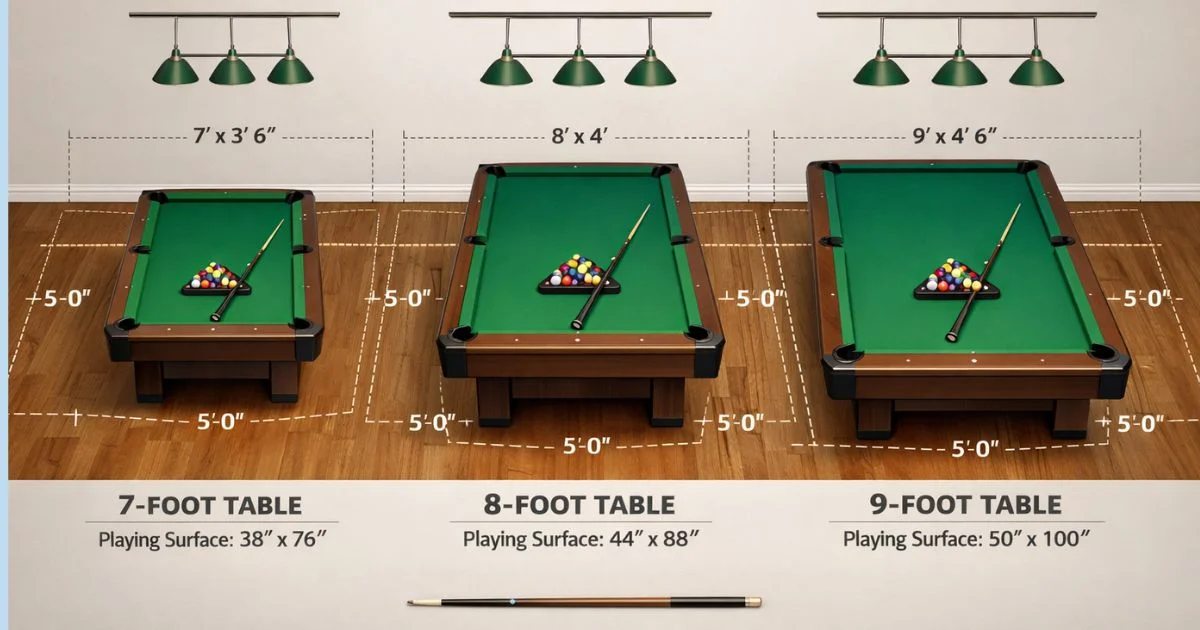
- Playing Surface: 44″ × 88″
Most popular for home game rooms.
9-foot Tournament
- Overall: 4.5 ft × 9 ft
- Playing Surface: 50″ × 100″
Professional standard for competitions.
Pool Table Sizes Quick Comparison
| Size | Overall Dimensions (Width × Length) |
Playing Surface (Width × Length) |
Common Use |
|---|---|---|---|
| 6-foot | 3 ft × 6 ft | ~34″ × 68″ | Tight spaces / Kids |
| 7-foot (Bar Box) | 3.5 ft × 7 ft | 39″ × 78″ | Bars & recreational |
| 8-foot | 4 ft × 8 ft | 44″ × 88″ | Home game rooms (most popular) |
| 9-foot | 4.5 ft × 9 ft | 50″ × 100″ | Tournaments & pros |
Playing surface is measured inside the cushions (standard 2:1 ratio). Overall dimensions include the frame/rails. Always allow at least 5 feet of clearance around the table for comfortable cueing.
The three most common pool table dimensions are 7-foot, 8-foot, and 9-foot tables. Each serves different purposes and fits different spaces.
A 7-foot table measures 3.5 feet wide by 7 feet long, with a playing surface of 39 inches by 78 inches. These are what you’ll find in most bars and pubs, which is why they’re called bar box tables. They’re perfect for recreational play and smaller game rooms.
The 8-foot pool table is the most popular choice for homes. It measures 4 feet wide by 8 feet long, with a playing surface of 44 inches by 88 inches. This size offers the best balance between authentic gameplay and reasonable space requirements.
Tournament-size tables are 9 feet long and 4.5 feet wide. The playing surface measures 50 inches by 100 inches. Professional players use these tables in competitions, and they require significantly more room space.
Compact 6-foot tables are also available for extremely tight spaces. They measure 3 feet wide by 6 feet long, making them ideal for learning the game or for children’s play areas.
Room Size Requirements for Your Pool Table

Room dimensions matter more than table size when planning your game room. You need clearance on all sides for players to use their cue sticks comfortably without hitting walls or furniture.
A standard cue stick measures 57 to 58 inches long. When calculating room size, you must add this cue length to each side of the table, plus extra space for your stance and stroke.
Here’s what you need for each table size with standard 58-inch cues:
6-foot table: Minimum room size of 12’4″ × 14’10” 7-foot table: Minimum room size of 12’9″ × 16’0″ 8-foot table: Minimum room size of 13’2″ × 16’10” 9-foot table: Minimum room size of 13’8″ × 17’10”
If you don’t have enough space for standard cues, shorter options work perfectly fine. 52-inch cues reduce room requirements by about 10 inches on each side. 48-inch cues save even more space.
With 52-inch cues, an 8-foot table needs just 12’0″ × 15’6″. With 48-inch cues, you can fit the same table in a room measuring 11’2″ × 15’0″. These shorter cues are also great for kids and teens who are just learning the game.
Choosing Between 6ft, 7ft, and 8ft Pool Tables
Pros
- Fits in very tight spaces
- Lower cost
- Great for kids & beginners
- Easy to move
Cons
- Limited shot variety
- Less realistic gameplay
- Not suitable for serious practice
Best when space is extremely limited (apartments, small rooms).
Pros
- Common in bars — familiar feel
- Good balance of size & playability
- More affordable than 8ft
- Fits most basements/garages
Cons
- Smaller than home/pro standard
- Some shots feel crowded
Dominant in recreational spaces — excellent budget-friendly competitive option.
Pros
- Home standard — authentic experience
- More room for strategic shots
- Great for skill development
- Balances space & gameplay perfectly
Cons
- Requires more room than 7ft
- Higher cost than smaller sizes
Most popular choice for serious home players.
Quick Size Comparison
| Size | Playing Surface | Best For | Space Needed (with cues) |
|---|---|---|---|
| 6-foot | ~34″ × 68″ | Kids, apartments, beginners | ~13 ft × 16 ft room |
| 7-foot | 39″ × 78″ | Bars, rec rooms, budget | ~13.5 ft × 17 ft room |
| 8-foot | 44″ × 88″ | Home standard, serious play | ~14 ft × 18 ft room |
Always measure your room and allow at least 5 feet clearance around the table for comfortable cueing (standard 58″ cue).
Cue Length and Wall Clearance Guidelines
Cue clearance determines whether your game room feels spacious or cramped. The standard 58-inch cue needs approximately 5 feet of clearance from the table’s edge to any wall or obstacle.
This measurement accounts for the cue stick length, the table rail width, your arm extension, and comfortable stance room. Cutting these clearances too close makes certain shots nearly impossible.
Wall distance should be at least 4.5 feet on all sides when using standard cues. This gives you enough room to address the ball properly and execute your stroke without restriction.
Many players keep a mix of cue lengths on hand. 52-inch and 48-inch cues handle those awkward corner shots near walls, doorways, or furniture. Some even keep 42-inch cues for extremely tight spots.
Consider everything in your room when planning cue clearance. Columns, beams, heating vents, and light fixtures can all interfere with your stroke. Don’t forget about door swings and traffic patterns either.
Other Dimensions: Twin Bed Dimensions 2026
Question’s
What is the size of a standard pool table?
Standard pool table sizes include 7-foot, 8-foot, and 9-foot tables. The most common standard size for home use is an 8-foot table measuring 4 feet wide by 8 feet long. The playing surface on an 8-foot table is 44 inches by 88 inches. All standard tables follow the regulation 2-to-1 ratio where length is exactly twice the width.
Are pub pool tables 6ft or 7ft?
Pub pool tables are typically 7 feet long. These bar box tables measure 3.5 feet wide by 7 feet long with a 39-inch by 78-inch playing surface. The 7-foot size became the pub standard because it fits well in commercial spaces while still providing good gameplay. Most coin-operated tables found in bars use this 7-foot dimension.
Can a pool table fit in a 12×12 room?
Yes, a 6-foot pool table can fit in a 12×12 room when using 48-inch cues. This setup provides approximately 4.5 feet of clearance on each side, which meets minimum requirements. However, a 7-foot or 8-foot table won’t work in a 12×12 space even with shorter cues. The room would feel too cramped for comfortable play.
Is a 7 foot pool table standard?
Yes, 7-foot tables are considered standard size for bars, pubs, and recreational spaces. They’re also called bar box tables or bar size tables. While 8-foot tables are more common in homes, 7-foot tables are perfectly legitimate standard sizes. They follow the regulation 2-to-1 ratio and provide excellent gameplay for casual and intermediate players.
How much space do I need to fit a pool table?
Space requirements depend on your table size and cue length. For an 8-foot table with standard 58-inch cues, you need a minimum room size of 13’2″ × 16’10”. A 7-foot table needs 12’9″ × 16’0″. A 9-foot table requires 13’8″ × 17’10”. Using shorter cues reduces these requirements by 6 to 12 inches per side.
Which is better, a 6ft or 7ft pool table?
A 7-foot pool table is significantly better than a 6-foot table for most players. The larger playing surface provides more realistic gameplay and better skill development. 6-foot tables work only when space is extremely limited or for young children learning the game. If your room can accommodate it, always choose the 7-foot option over 6 feet.
How far should a pool table be away from a wall?
Your pool table should be at least 5 feet from any wall when using standard 58-inch cues. This distance allows proper cue clearance for all shots around the table. With 52-inch cues, you can reduce this to 4.5 feet. With 48-inch cues, 4 feet of clearance works. Never place a table closer than 4 feet to a wall regardless of cue length.
Should I get a 7 or 8 ft pool table?
Choose an 8-foot table if your room measures at least 13’2″ × 16’10” and you’re serious about improving your game. Pick a 7-foot table if space is limited or you play mainly for casual recreation. The 8-foot size offers better gameplay and higher resale value. The 7-foot size fits more rooms and costs less. Both are legitimate standard sizes.
What’s the difference between pool & billiards?
Pool is actually a type of billiards. Billiards is the umbrella term covering all cue sports including pool, snooker, and carom. Pool tables use pockets and typically measure 7 to 9 feet. Snooker tables are larger at 12 feet. Carom billiards uses pocketless tables. When Americans say “billiards,” they usually mean pocket billiards, which is pool.
Conclusion
Standard pool table dimensions range from 6 to 9 feet, with 8-foot tables being the most popular choice for homes. The key to a successful game room is matching your table size to your available room space while ensuring adequate cue clearance on all sides.
Measure your room carefully, account for 58-inch standard cues or shorter alternatives, and use the minimum space requirements provided in this guide. With proper planning, you’ll create a game room that delivers years of enjoyment without compromising on comfort or gameplay quality.

Haru, the dedicated Admin of candimension.com, curates an informational blog on Can Dimension. With passion and expertise, Haru delivers insightful articles to educate and empower readers on this fascinating niche.