Shopping for a new dishwasher? The wrong size can turn your dream appliance into a nightmare. Standard dishwasher dimensions matter more than most homeowners realize.
Getting the measurements right saves you from costly returns, installation headaches, and cabinet modifications. This guide breaks down everything you need to know about dishwasher sizes before you buy.
Standard Dishwasher Dimensions
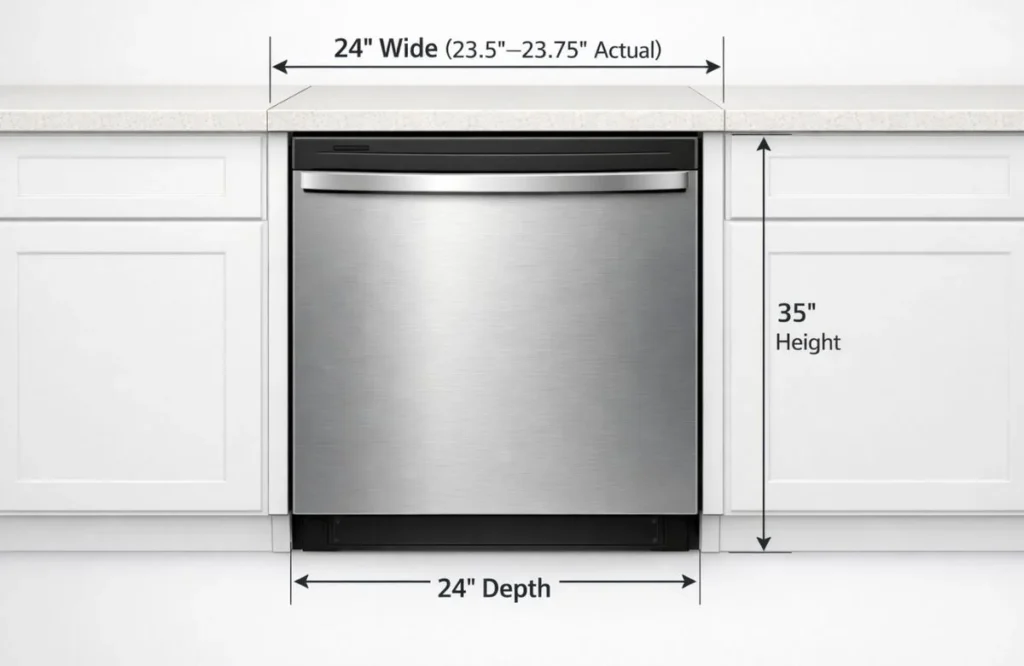
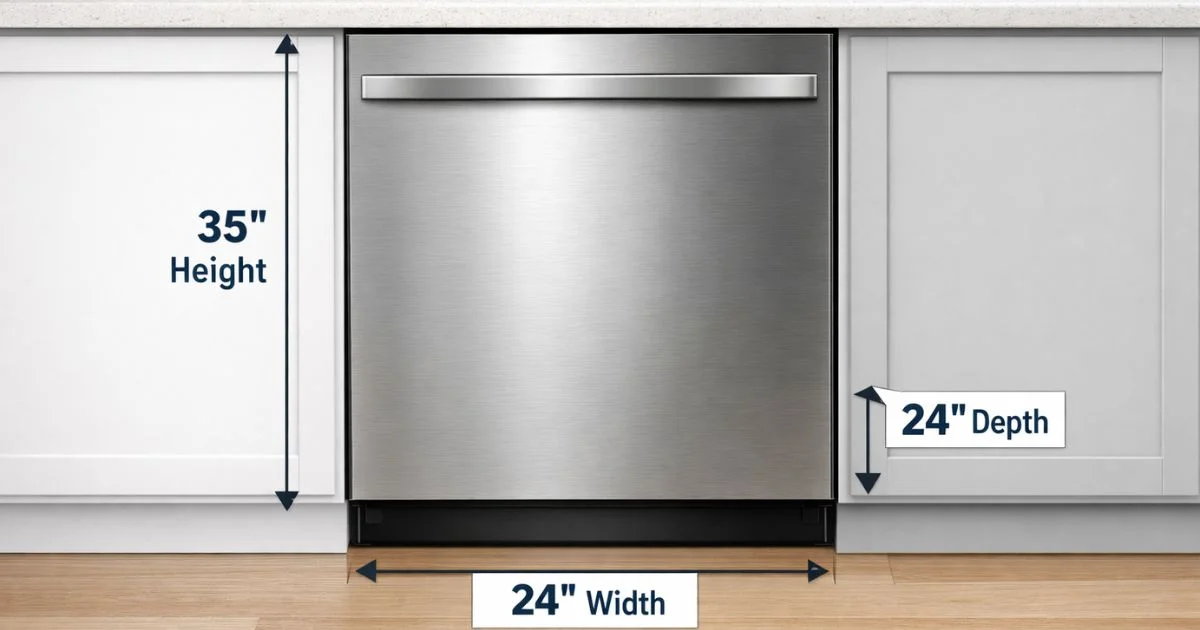
Most dishwashers in the USA follow a standard size. The typical built-in model measures 24 inches wide, 24 inches deep, and 35 inches tall. These dimensions became the industry norm because they fit standard kitchen cabinet openings.
Your cabinet opening should match these measurements. However, the actual dishwasher width is usually slightly smaller—around 23.5 to 23.75 inches. This gives you the wiggle room needed for installation.
Standard Built-In Dishwasher Size Breakdown
Width stands at 24 inches for most models. This measurement fits the space between standard kitchen cabinets. Manufacturers design dishwashers to slide into these openings with minimal gaps.
Depth runs 24 inches from front to back. This allows the unit to sit flush with your countertops. Some models with protruding handles may extend slightly beyond the cabinet face.
Height ranges from 34 to 36 inches tall. Most units measure 35 inches, which fits under standard countertops. The actual appliance is about a half-inch shorter than the opening to allow for leveling feet adjustments.
Non-Standard Dishwasher Sizes Explained
Compact dishwashers measure 18 inches wide. These smaller units work perfectly in apartments, small kitchens, or as a secondary dishwasher. The depth and height remain the same as standard models at 24 inches deep and 35 inches tall.
A 22-inch wide dishwasher doesn’t exist as a standard size. Manufacturers stick to 18-inch or 24-inch widths. If you have a 22-inch opening, you’ll need to modify your cabinets or choose an 18-inch model with filler strips.
No mainstream 20-inch wide dishwasher is available either. The jump goes straight from 18 inches to 24 inches in the U.S. market. European models sometimes use metric sizing, which translates differently.
Oversized models range from 30 to 42 inches wide. These extra-large units handle bigger loads but require custom cabinet configurations. They’re less common and typically found in high-end kitchen remodels.
European sizing uses centimeters, not inches. A 60cm dishwasher equals approximately 23.6 inches, matching U.S. standards. The 55cm depth measurement converts to about 21.7 inches, which is slightly shallower than American models.
How to Measure Your Space for a Dishwasher
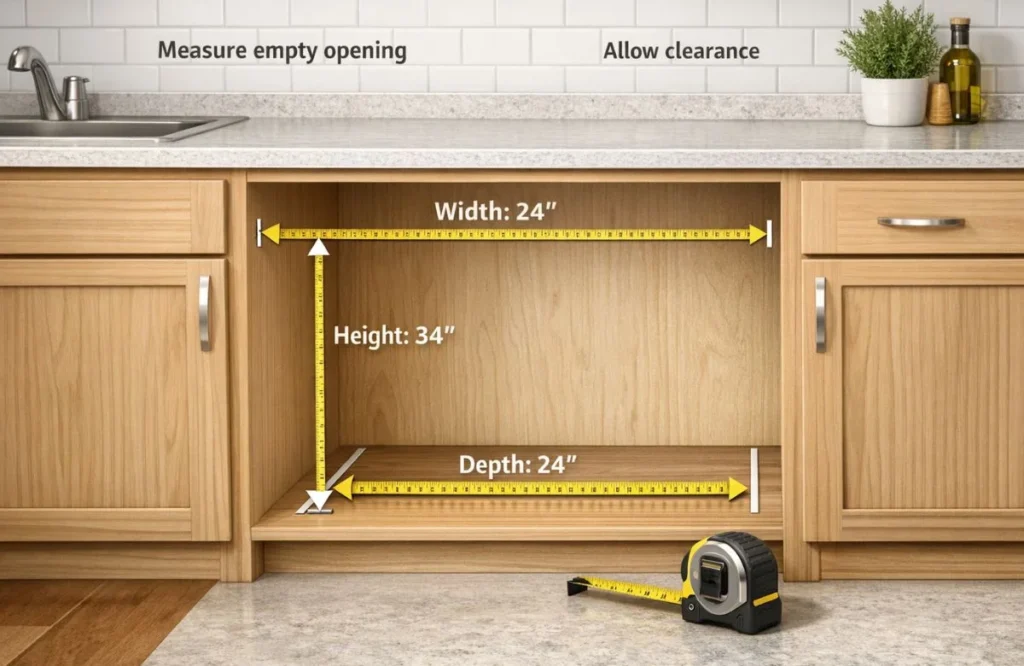
Accurate measurements prevent expensive mistakes. You need three critical numbers: width, height, and depth. Measure the empty cabinet opening, not an existing dishwasher.
Step 1 – Measuring Dishwasher Opening Width
Measure from the inside edge of one cabinet to the other. Place your tape measure at the left cabinet’s inner wall and extend it to the right cabinet’s inner wall. Record this number in inches.
Take measurements at both the top and bottom. Cabinets aren’t always perfectly square. If the numbers differ, use the smaller measurement—this ensures your dishwasher will fit.
Leave about a quarter-inch on each side for breathing room. A 24-inch opening should house a dishwasher that’s 23.5 inches wide. This small gap makes installation easier and accounts for any cabinet irregularities.
Don’t assume your opening matches the old dishwasher. Previous owners might have used filler strips or made modifications. Always measure the actual opening space.
Step 2 – Measuring Dishwasher Opening Height
Measure from the floor to the underside of your countertop. Put your tape measure on the floor where the dishwasher sits. Extend it straight up to the lowest point of the counter above.
Check both the front and back of the opening. Floors and counters can slope slightly. Use the shorter measurement if they differ. Most standard dishwasher heights need 34.5 to 36 inches of clearance.
Consider your flooring carefully. If you have multiple layers of flooring or plan to add new flooring, factor this into your height measurement. The floor under an old dishwasher might be lower than the rest of your kitchen.
Most dishwashers have adjustable feet. These screw-in legs let you add or remove about an inch of height. This feature helps you level the unit and make fine adjustments during installation.
Step 3 – Measuring Dishwasher Opening Depth
Measure from the back wall to the front edge of your cabinets. Start at the rear of the opening and pull the tape forward. Stop at the point where your cabinet doors sit when closed.
The standard depth is 24 inches. This lets the dishwasher sit flush with your cabinets. However, the door adds extra depth when you open it.
Allow at least 27 inches of clearance in front of the unit. You need this space to fully open the door and pull out the racks. Measure from the cabinet front to any islands, walls, or obstacles.
Handles and controls affect the overall depth. A dishwasher with a bar handle sticks out further than a model with a pocket handle. Check the spec sheet for the exact depth including the door and handle.
Space Requirements Around Your Dishwasher
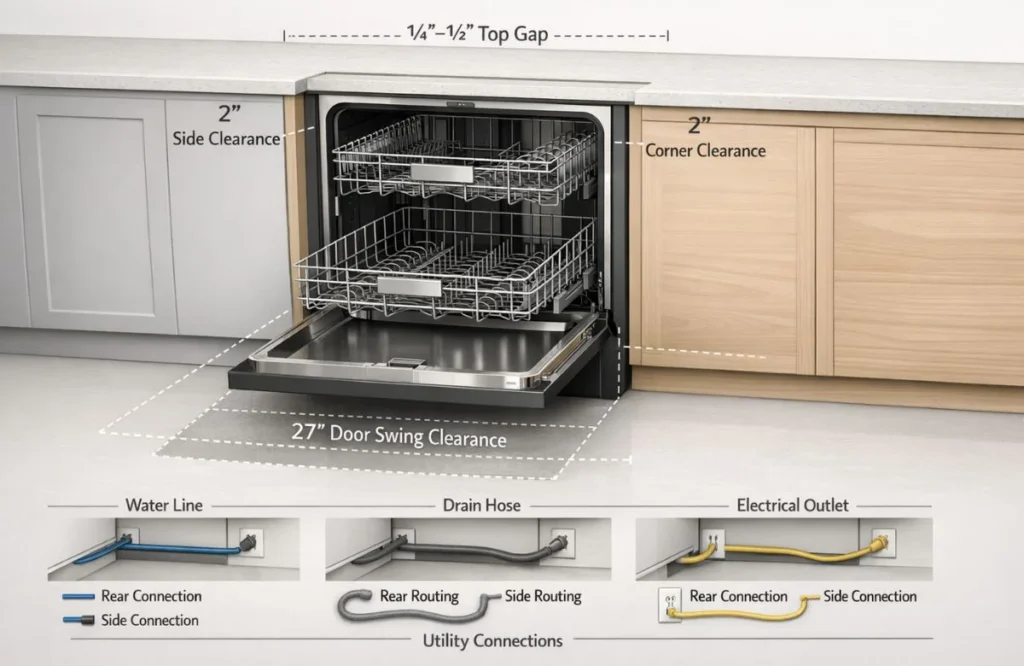
Proper clearance keeps your dishwasher working efficiently. Cramming a unit into a tight space causes problems. Air circulation, door operation, and access all require adequate room.
The minimum space needed includes more than just the opening. You must plan for door swing, side clearances, and service access. Skipping these requirements leads to installation failures.
Door Swing Clearance
You need 27 inches of clear space in front of the dishwasher. This allows the door to open fully and lets you pull the racks out completely. Measure from the front of your cabinets to any obstacles.
Islands and kitchen traffic paths matter here. If your dishwasher sits across from an island, make sure you have enough room to walk past with the door open. A tight squeeze makes loading and unloading frustrating.
Side and Corner Clearances
Leave 2 inches between the dishwasher and any wall or cabinet. This spacing is critical for corner installations. The door needs room to swing open without hitting adjacent surfaces.
Corner placements require extra planning. When a dishwasher sits next to a perpendicular wall or cabinet, that 2-inch buffer prevents the door edge from scraping or jamming.
Top Clearance and Countertop Gap
A small gap between the dishwasher top and countertop is normal. Most units sit about a quarter-inch to half-inch below the counter. This space lets you slide the appliance in and out if needed.
The dishwasher shouldn’t touch the underside of the counter. Direct contact can cause vibration noise and damage over time. Proper leveling feet maintain the right distance.
Utility Connection Considerations
Check where your electrical outlet and water lines are located. Some kitchens have utilities in the adjacent cabinet, while others route them through the back wall. Know these positions before measuring.
Outlets directly behind the dishwasher reduce depth clearance. If your electrical box protrudes into the opening, you might need a shallower model or have an electrician relocate the outlet.
Dishwasher Size Variations and Capacity
Exterior dimensions don’t tell the whole story. Two dishwashers with identical outside measurements can hold different amounts of dishes. Interior design makes the difference.
Standard capacity ranges from 12 to 16 place settings. A place setting includes a dinner plate, salad plate, bowl, cup, saucer, and silverware. Larger families need higher capacity models.
How Interior Layout Affects Capacity
Third rack dishwashers pack in more items. This extra top level holds utensils, cooking tools, and small items. It frees up space below for larger plates and bowls.
Compact 18-inch models hold 8 to 10 place settings. These smaller units work fine for couples or small households. The reduced dishwasher width means less space inside for dishes.
Oversized 30 to 42-inch models handle 16 or more place settings. Restaurant-style loads fit easily in these units. However, you’ll need a custom kitchen layout to accommodate the extra width.
Tall Tub vs. Standard Tub Height
Tall tub dishwashers maximize vertical space inside. They use the same 35-inch external height but offer a deeper interior cavity. This design fits larger pots, pans, and serving dishes.
Standard tub models have a slightly shorter interior. The difference is only an inch or two, but it matters when loading big items. Check interior dimensions if you regularly wash oversized cookware.
Panel-Ready Models and Depth Adjustments
Panel-ready dishwashers accept custom cabinet panels. These fronts add thickness to the door, increasing the overall depth by about three-quarters of an inch. Factor this into your dishwasher depth measurements.
Integrated control panels sit on top of the door. This design keeps buttons hidden when closed, creating a sleek look. It doesn’t change the depth like a custom panel does.
Questions and Installation Tips
Real-world installations raise practical questions. Even with perfect measurements, unique situations pop up. Here’s how to handle common scenarios.
Not every kitchen follows standard rules. Older homes, custom builds, and renovations often have quirky dimensions. Solutions exist for nearly every challenge.
Does My Dishwasher Need to Be Flush with Cabinets?
Flush installation looks cleaner and more professional. The dishwasher door should align with the front edge of your cabinets. This creates a seamless appearance in your kitchen.
Pocket handles allow perfect flush mounting. These recessed pulls don’t stick out beyond the door face. Bar handles protrude and will extend past the cabinet line.
Custom panels help achieve a built-in look. Adding a cabinet front to your dishwasher makes it blend completely with surrounding cabinetry. This option works best with panel-ready models.
What If My Opening Doesn’t Match Standard Sizes?
Non-standard openings require creative solutions. You have several options depending on how much your space differs from the norm.
Filler strips close small gaps. If your opening is slightly wider than 24 inches, installers use thin wood strips on one or both sides. These pieces match your cabinet finish.
Cabinet modification works for larger adjustments. A carpenter can reframe the opening to accommodate a different size dishwasher. This costs more but solves sizing problems permanently.
Portable dishwashers offer flexibility. These freestanding units roll into place and connect to your sink faucet. They work when built-in installation isn’t possible.
Countertop dishwashers fit tight spaces. These compact units sit on your counter like a microwave. They’re smaller than 18-inch models but require no cabinet opening.
Important Installation Tips from Professionals
Always measure the empty opening, not the old appliance. Previous dishwashers might have used shims, spacers, or non-standard mounting. Remove everything first.
Multiple flooring layers affect height measurements. Vinyl, tile, or laminate added over original flooring raises the floor level. The space under an old dishwasher might be lower.
Check utility connection locations before buying. Knowing where water, drain, and electrical lines sit helps you choose compatible models. Some dishwashers have connections on the left, others on the right.
Hire a professional installer if you’re unsure. Incorrect installation voids warranties and causes leaks. Licensed plumbers and appliance installers know local codes and requirements.
Keep your installation manual during measurement. Each model has specific clearance requirements. The manual lists exact dimensions and spacing needs for your particular dishwasher.
Other Dimensions: Pool Table Dimensions: Table and Room Size
Question’s
What is the standard size of a dishwasher?
The standard dishwasher measures 24 inches wide, 24 inches deep, and 35 inches tall. These dimensions fit the cabinet openings in most American kitchens.
How much space is required for a dishwasher?
You need a 24-inch wide opening for standard models. The cabinet space should measure 24 inches deep and 34.5 to 36 inches tall. Additionally, leave at least 27 inches of clear floor space in front of the dishwasher for the door to open fully. Corner installations require 2 inches of side clearance.
Is a 24 inch dishwasher actually 24 inches wide?
No, a 24-inch dishwasher is slightly narrower than 24 inches. The actual width ranges from 23.5 to 23.75 inches. Manufacturers label dishwashers by the cabinet opening size they fit, not their exact dimensions. This smaller size allows installation clearance and accounts for minor cabinet irregularities.
How wide of an opening do I need for a dishwasher?
A standard dishwasher requires a 24-inch wide cabinet opening. Compact models need an 18-inch opening. Measure from the inside edge of one cabinet to the inside edge of the other. The opening should be slightly larger than the dishwasher itself to allow the unit to slide in smoothly.
Are all dishwashers 55cm deep?
No, American dishwashers are 24 inches deep, which equals 61 centimeters. The 55cm measurement you see refers to European models, which convert to about 21.7 inches. U.S. and European dishwashers use different sizing standards.
Is there a 20 inch wide dishwasher?
No major manufacturer produces a 20-inch wide dishwasher. Standard sizes jump from 18 inches to 24 inches in the U.S. market. If you have a 20-inch opening, you can install an 18-inch dishwasher with filler strips on the sides, or modify your cabinets to accommodate a 24-inch model.
Are all dishwashers 600 wide?
Not all dishwashers are 600mm (23.6 inches) wide. This measurement is close to the U.S. standard of 24 inches but comes from European sizing. American dishwashers specifically measure 24 inches, while European models use metric measurements. Compact models are 18 inches (approximately 45cm) in the U.S. market.
What is the width of space required to install a dishwasher?
You need a 24-inch wide space for standard dishwasher installation. This measurement is for the cabinet opening between adjacent cabinets. Compact models require an 18-inch space. The opening should be measured at both the top and bottom to ensure it’s consistent, using the smaller measurement if they differ.
Is there a 22 inch wide dishwasher?
No, 22-inch wide dishwashers are not available as a standard size. Manufacturers produce 18-inch and 24-inch models in the U.S. market, with nothing in between. For a 22-inch opening, install an 18-inch dishwasher with 2-inch filler strips on each side, or have a carpenter expand the opening to 24 inches.
Conclusion
Standard dishwasher dimensions are 24 inches wide, 24 inches deep, and 35 inches tall. These measurements fit most American kitchens perfectly. Always measure your cabinet opening carefully before shopping.
Take width, height, and depth measurements twice. Use the smallest number if measurements vary. Remember that the actual appliance is slightly smaller than the listed size to allow installation room.
Non-standard spaces have solutions. Compact 18-inch models work in tight spots. Filler strips, cabinet modifications, or portable dishwashers handle unusual openings. Measure first, then choose the right size for your kitchen.