Setting up a badminton court requires precise measurements. Whether you’re building a home court or managing a sports facility, understanding the exact badminton court dimensions ensures proper gameplay and player safety.
The standard badminton court size follows regulations set by the Badminton World Federation (BWF). Getting these measurements right makes the difference between a professional-quality court and a frustrating playing experience.
Visit Queendimensions.com for More Interesting Measurements
Standard Badminton Court Size – Official Measurements
Overall Badminton Court Dimensions
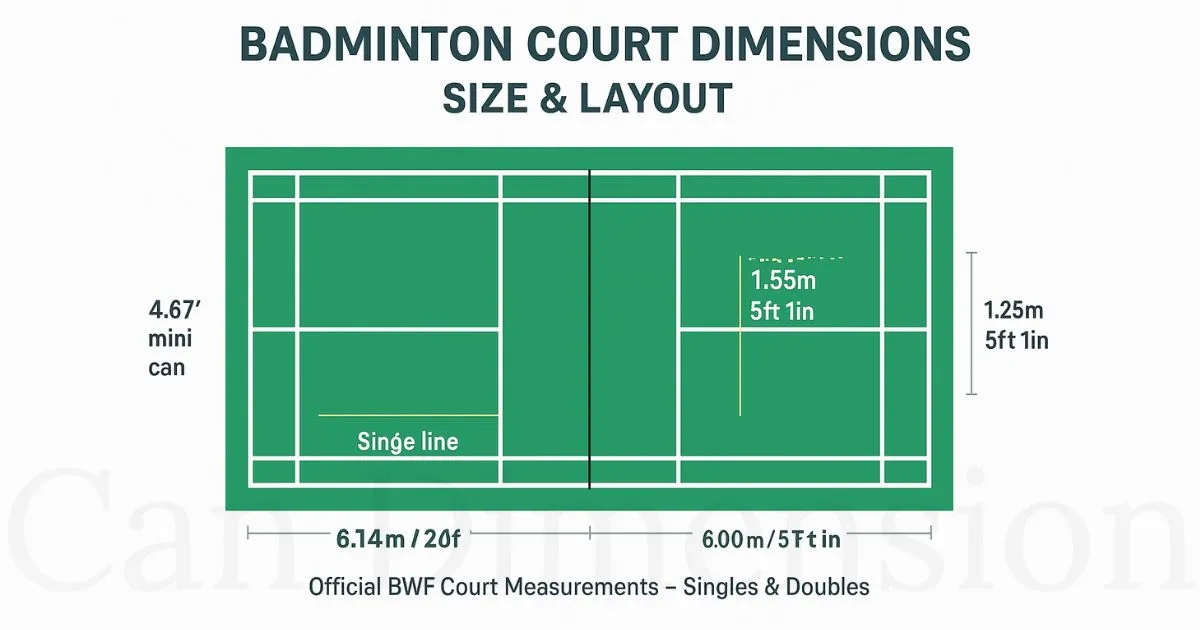
The official badminton court measures 13.4 meters long and 6.1 meters wide for doubles play. In imperial units, that’s exactly 44 feet by 20 feet.
For singles matches, the court length stays the same at 13.4 meters (44 feet). However, the width narrows to 5.18 meters or 17 feet.
The total playing area for a doubles court covers 81.74 square meters (880 square feet). Singles courts take up 69.41 square meters (747 square feet). These measurements apply to all regulation badminton courts worldwide.
Badminton Court Dimensions
Quick reference for metric and imperial units – consistent for professional tournaments and recreational play per BWF regulations.
Quick Tips to Avoid Confusion:
- Length: Full court from baseline to baseline – same for singles & doubles.
- Width: Doubles uses the full 6.1 m; singles narrows to 5.18 m (service lines differ).
- Net: Slightly higher at posts for tautness; center dips to 1.524 m.
- Universal Standard: BWF rules apply everywhere – no variations by location!
Badminton Court Layout

Court Line Markings and Specifications
All boundary lines on a badminton court must be 40mm wide (approximately 1.57 inches). The lines appear in either white or yellow to ensure maximum visibility against the playing surface.
These markings define the court boundaries and service areas. Clear, well-maintained lines prevent disputes during matches and help players make accurate shots.
Quality line paint or tape ensures durability. Indoor courts typically use specialized court marking paint that withstands constant foot traffic. The markings should remain visible but not create slippery conditions.
Service Court Dimensions
The short service line sits 1.98 meters (6.5 feet) from the net. This line defines where serves must land for legal play.
For doubles, the long service line runs along the back boundary. In singles play, there’s an additional line 0.76 meters (2.5 feet) from the baseline that serves as the back service limit.
A center line divides the court into left and right service boxes. Servers must hit diagonally into the opposite service court. These precise measurements ensure fair play across all skill levels.
Singles vs. Doubles Court Layout
The singles court measures 13.4m × 5.18m while the doubles court expands to 13.4m × 6.1m. This means doubles players get an extra 0.46 meters (1.5 feet) on each side.
The side alleys only count during doubles play. In singles matches, shots landing in these outer corridors are considered out of bounds.
During doubles, teams use the full width for rallies but follow specific service court boundaries. The back tramline matters only for singles serves. Understanding these differences prevents common rule violations.
Badminton Net Height and Placement

Official Net Specifications
The badminton net height at the center measures exactly 1.524 meters (5 feet). At the posts, it rises slightly to 1.55 meters (5 feet 1 inch).
This slight dip creates a natural curve. The net spans 6.1 meters wide to cover the full doubles court width. Quality nets have a minimum depth of 760mm with small mesh openings.
The mesh size prevents the shuttlecock from passing through while maintaining visibility. Tournament-grade nets use 20mm mesh squares made from dark-colored cord.
Net Post Positioning
Net posts stand on the doubles sideline, not outside it. They’re positioned to hold the net taut without interfering with play.
The posts must be sturdy enough to maintain proper net tension. Wobbling or loose nets disrupt gameplay and create safety hazards.
Professional facilities often use weighted bases or floor-mounted systems. Home courts can use portable posts with sufficient stability. The key is keeping the net at regulation height throughout its span.
Space Requirements for Your Badminton Court

Minimum Space Needed
The court itself takes 13.4m × 6.1m, but that’s not enough for safe play. You need additional clearance on all sides for player movement.
Minimum playable space requires 14.63 meters by 7.32 meters (48 feet by 24 feet). This adds roughly one meter of buffer around the court boundaries.
Without adequate clearance, players risk injuries from running into walls or obstacles. The International Badminton Federation considers these minimums for basic recreational play.
Recommended Space for Optimal Play
For comfortable, competitive play, aim for 17.41 meters by 10.10 meters (57.12 feet by 33.14 feet). This provides proper safety margins and allows full player mobility.
Back court clearance should be 1.5 to 2 meters minimum behind each baseline. Side clearance needs 1 to 1.5 meters from the sidelines.
Indoor facilities require ceiling heights of at least 9 meters (30 feet). Professional tournaments prefer 12 meters (39 feet) to prevent shuttlecock interference. These specifications appear in official BWF facility guidelines.
Multiple Court Configurations
When installing multiple courts, maintain minimum 2-meter spacing between adjacent playing areas. This prevents players from interfering with neighboring matches.
Side-by-side arrangements work well for facilities with limited length but good width. End-to-end configurations suit long, narrow buildings.
Multipurpose facilities often accommodate 2-4 courts in standard gymnasium spaces. Proper spacing and clear markings for each court prevent confusion during busy play times.
Badminton Court Dimensions Compared to Other Sports

Badminton vs. Tennis Court Size
A tennis court dwarfs a badminton court at 23.77 meters by 10.97 meters (78 feet by 36 feet) for doubles. That’s nearly 1.5 times larger in total area.
Tennis courts occupy 260.87 square meters compared to badminton’s 81.74 square meters. The size difference reflects the different playing styles and equipment.
Tennis nets sit lower at 0.91 meters (36 inches) in the center. The larger court and lower net accommodate the heavier tennis ball and different shot trajectories. This comparison helps facilities plan multi-sport court conversions.
Badminton vs. Pickleball Court Dimensions
Here’s something interesting: pickleball and badminton doubles courts share identical dimensions at 20 feet by 44 feet (6.1m × 13.4m).
However, the net heights differ significantly. Pickleball nets measure 36 inches at sidelines and 34 inches at center. Badminton nets stand at 60 inches (5 feet).
Pickleball courts include a 7-foot non-volley zone (the “kitchen”) on each side of the net. Badminton has no equivalent zone. The court lines and service rules also differ despite the matching dimensions.
Badminton vs. Squash Court Size
Squash courts measure 9.75m × 6.4m (32 feet × 21 feet), making them smaller than badminton courts. Squash is an enclosed court sport with walls as part of play.
The comparison shows how court dimensions reflect gameplay demands. Badminton needs length for powerful smashes and clears. Squash focuses on wall play in a compact space.
Professional vs. Recreational Court Standards
BWF Tournament Court Requirements
Official competition courts must meet strict BWF specifications with zero tolerance for dimensional errors. Tournament organizers face penalties for non-compliant facilities.
Competition venues need expanded clearance zones. International tournaments require 2 meters on sides and 2.5 meters at ends as minimum spacing.
The court surface color must be dark (typically green or blue) to contrast with white shuttlecocks and yellow lines. Surface reflectivity has limits to prevent glare.
Professional lighting systems exceed 750 lux with specific distribution patterns. Even lighting prevents advantages or disadvantages based on court position.
Recreational and Home Court Flexibility
Home courts can compromise slightly on clearance space while maintaining official court dimensions. A few inches less buffer won’t ruin casual games.
Ceiling height becomes more critical than exact side clearance. You can play with tight side boundaries, but low ceilings fundamentally change gameplay.
Recreational surfaces don’t require professional-grade materials. A flat, clean concrete surface with proper markings serves adequately for practice.
Safety should never be compromised. Even casual setups need adequate clearance to prevent injuries during enthusiastic play.
Cost Considerations for Badminton Court Installation
Court size directly impacts installation costs. Full-size courts require more materials, labor, and space rental/purchase.
Indoor facilities face higher per-square-foot costs than outdoor setups. Climate control, lighting, and specialized flooring add expenses.
Professional installation for indoor courts ranges from $10,000-30,000+ depending on surface quality and location. Outdoor courts cost significantly less at $2,000-8,000.
DIY setups cut labor costs but require time and skill. Budget $500-2,000 for quality portable equipment and marking supplies.
Long-term maintenance includes surface refinishing, line remarking, and net replacement. Indoor courts need annual upkeep budgets of $500-2,000.
Other Dimensions: Can Koozie Dimensions: Size, Height and Length
Question’s
What are the dimensions of a badminton court?
A standard badminton court measures 13.4 meters long by 6.1 meters wide (44 feet by 20 feet) for doubles play. Singles courts use the same length but narrow to 5.18 meters (17 feet) wide. These official dimensions apply worldwide.
Is a badminton court 20 feet by 44 feet?
Yes, exactly. The doubles badminton court dimensions are 20 feet wide by 44 feet long in imperial measurements. This converts to 6.1 meters by 13.4 meters in metric units.
How much space is needed for a badminton court?
Minimum space requirements are 14.63m × 7.32m (48ft × 24ft) for basic play. However, optimal space measures 17.41m × 10.10m (57.12ft × 33.14ft) to allow safe player movement and proper clearance zones.
What is the size of a badminton court and pickleball court?
Both sports use identical court dimensions of 20 feet by 44 feet (6.1m × 13.4m). The key differences are net height and line markings. Badminton nets stand at 5 feet center height while pickleball nets measure 34 inches at the center.
Which is harder, pickleball or badminton?
Badminton is generally more challenging due to faster pace, greater physical demands, and steeper learning curve. The shuttlecock travels faster than a pickleball, requiring quicker reflexes. Badminton demands more agility and stamina for full-court movement.
What is the 10-second rule in pickleball?
The 10-second rule requires servers to begin serves within 10 seconds of the score being called. This is a pickleball-specific rule that doesn’t apply to badminton.
Is a badminton court the same size as a tennis court?
No, tennis courts are significantly larger. A tennis doubles court measures 23.77m × 10.97m (78ft × 36ft) compared to badminton’s 13.4m × 6.1m (44ft × 20ft). Tennis courts are nearly 1.5 times larger in total area.
What are the 10 main rules of badminton?
Games play to 21 points with a two-point lead required (up to 30 points). Players serve diagonally from below waist height. Each player hits the shuttle once per turn. No touching the net during play. The shuttle must land within boundaries. These core rules govern all badminton matches.
How to make a badminton court?
Start by measuring a 44ft × 20ft space with adequate clearance. Mark boundaries with 40mm wide lines in white or yellow. Install a 5-foot high net at center. Ensure the surface is flat, non-slip, and properly marked. Add proper lighting for indoor courts.
Conclusion
Understanding proper badminton court dimensions ensures quality play and player safety. The standard 44 feet by 20 feet doubles court provides the foundation for the sport worldwide.
Whether building a professional facility or home court, following BWF specifications guarantees regulation compliance. Adequate clearance space matters as much as the court dimensions themselves.

Haru, the dedicated Admin of candimension.com, curates an informational blog on Can Dimension. With passion and expertise, Haru delivers insightful articles to educate and empower readers on this fascinating niche.