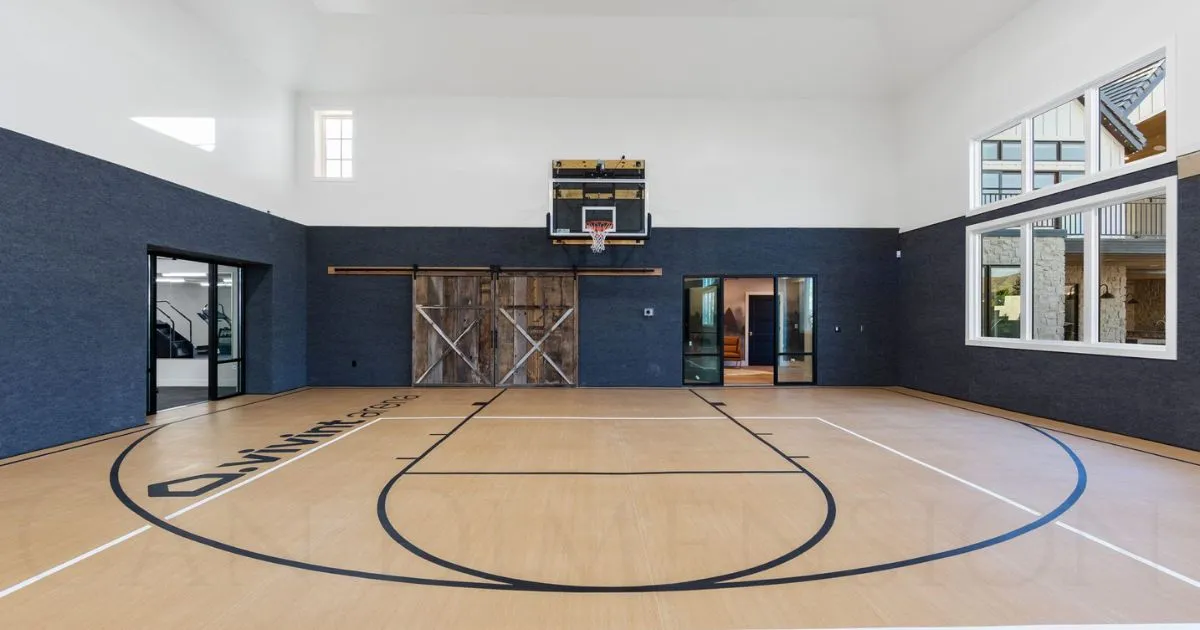
Basketball court dimensions vary by level of play, but understanding the standard measurements is essential for anyone planning a court or improving their game.
Whether you’re building a backyard court or coaching high school players, knowing the exact basketball court size helps you create proper training environments.
This guide breaks down official court dimensions, markings, and regulations for NBA, high school, and recreational play.
Basketball Court Dimensions Comparison
Compare key dimensions across different basketball court types. All courts share a rim height of 10 feet. The key (paint) width is typically 16 feet for high school and professional levels (12 feet in some youth leagues). Line markings are 2 inches wide in contrasting colors for visibility.
| Court Type | Length | Width | Total Area | 3-Point Distance | Free Throw Distance |
|---|---|---|---|---|---|
| NBA Professional | 94 feet | 50 feet | 4,700 sq ft | 23’9″ (22′ corners) | 15 feet |
| NCAA College | 94 feet | 50 feet | 4,700 sq ft | 22’1.75″ | 15 feet |
| High School | 84 feet | 50 feet | 4,200 sq ft | 19’9″ | 15 feet |
| Junior High | 74 feet | 42 feet | 3,108 sq ft | 19’9″ | 15 feet |
| Half Court | 47 feet | 50 feet | 2,350 sq ft | Varies | 15 feet |
| FIBA International | 91.9 feet | 49.2 feet | 4,520 sq ft | 22’1.75″ | 15 feet |
Quick Highlights to Avoid Confusion
- Free Throw Line: Consistent at 15 feet across all levels—no surprises here!
- 3-Point Line: Varies most (e.g., NBA’s longer arc for pros vs. shorter for youth). Corners are shorter in NBA for strategy.
- Size Scaling: Full courts (NBA/NCAA) are largest; Junior High smallest for younger players.
- Half Court: Used in practice—3-point distance adapts to setup.
Standard Basketball Court Dimensions by Level
NBA & Professional Basketball Court Size
Dimensions
Length: 94 feet
Width: 50 feet
Total Area: 4,700 sq ft
Safety & Design
Mandatory clearance zone around the perimeter for player safety.
Minimum 10-foot ceilings required.
Polished maple hardwood flooring—level and free from dead spots.
Boundary Lines
Baselines: 50 feet along each end.
Sidelines: 94 feet down the length.
All lines: Exactly 2 inches wide in contrasting colors.
Professional courts prioritize precision and safety for elite play, ensuring consistent ball bounce and ample space.
High School Basketball Court Dimensions
Dimensions
Length: 84 feet (10 feet shorter than NBA)
Width: 50 feet (same as NBA)
Junior High Variant: 74 feet by 42 feet
Standards
Follows NFHS (National Federation of State High School Associations) guidelines.
Reduced length fits smaller gymnasiums while preserving spacing.
Ideal for developing stamina and skills in younger athletes.
Surface & Lines
Line width: Same 2 inches as pros.
Surfaces: Hardwood or synthetic, based on budget/facility.
High school courts balance accessibility with competitive standards, making them versatile for school programs.
College & NCAA Basketball Court Size
Dimensions
Length: 94 feet (matches NBA)
Width: 50 feet (matches NBA)
Total Area: 4,700 sq ft
Regulations
Governed by NCAA for men’s and women’s basketball.
Consistent sizing promotes fair play across college levels.
Key Difference from NBA
3-Point line closer to the basket—shifts offensive strategies.
(NBA: 23’9″ arc; NCAA: 22’1.75″)
Encourages more perimeter shooting in college.
NCAA courts mirror pro sizes but tweak shooting distances for student-athlete development and game flow.
Universal Court Features (Across All Levels)
- Rim Height: 10 feet standard—no variations.
- Free Throw Distance: 15 feet consistent.
- Line Markings: 2 inches wide, contrasting colors for clarity.
- Key (Paint) Width: 16 feet (pro/HS); 12 feet in some youth.
NBA & Professional Basketball Court Size
An NBA basketball court measures 94 feet long by 50 feet wide. This creates a total playing area of 4,700 square feet. The court includes a mandatory clearance zone around the perimeter for player safety.
Professional courts require 10-foot ceilings minimum. Indoor NBA arenas typically feature polished maple hardwood flooring. The court surface must be level and free from dead spots that affect ball bounce.
The baseline runs 50 feet along each end. Sidelines extend 94 feet down the length. All boundary lines measure exactly 2 inches in width and appear in contrasting colors to the playing surface.
High School Basketball Court Dimensions
High school basketball courts measure 84 feet by 50 feet. This makes them 10 feet shorter than NBA courts but the same width. Most state athletic associations follow National Federation of State High School Associations (NFHS) standards.
The reduced length accommodates smaller gymnasiums while maintaining proper spacing. Junior high courts sometimes measure 74 feet by 42 feet for younger players still developing stamina and skills.
High school courts use the same 2-inch line width as professional courts. The playing surface varies from hardwood to synthetic materials depending on budget and facility type.
College & NCAA Basketball Court Size
NCAA basketball courts match NBA dimensions at 94 feet by 50 feet. College programs follow regulations set by the National Collegiate Athletic Association for both men’s and women’s basketball.
The key difference between NCAA and NBA courts appears in the three-point line distance. College courts position this arc closer to the basket than professional courts, creating different offensive strategies.
Basketball Court Markings Explained
Essential Court Lines and Boundaries
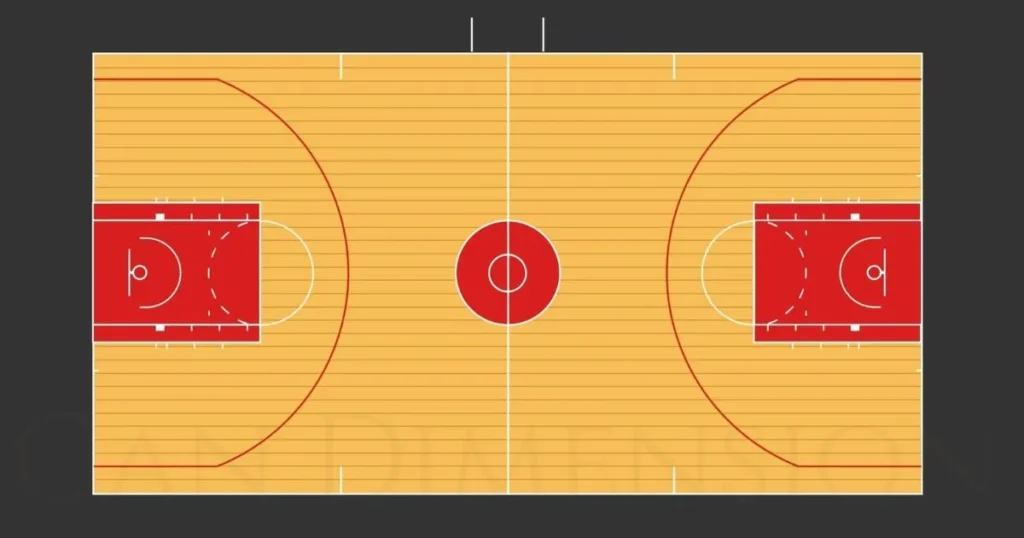
Sidelines run the full 94-foot length (84 feet for high school) along each side of the court. These out-of-bounds lines determine when the ball leaves play. Referees watch these lines closely during games.
Baselines span the 50-foot width at each end behind the hoops. Teams defend one baseline and attack the other. The baseline also serves as the boundary for inbounding plays after scores.
The mid-court line divides the court into two equal halves. Offensive teams must advance the ball past this line within 10 seconds in NBA play. This line prevents teams from stalling in their backcourt.
The Three-Point Line & Free Throw Areas
The three-point arc distance varies by level. NBA courts place this line 23 feet 9 inches from the basket at the top of the arc. In the corners, the distance shortens to 22 feet due to court width constraints.
High school basketball uses a 19 feet 9 inch three-point line. NCAA men’s basketball recently moved their arc to 22 feet 1.75 inches to match international standards. These differences significantly impact shooting strategies.
The free throw line sits 15 feet from the backboard across all levels. Players shoot uncontested foul shots from this line. The distance remains consistent from youth basketball through professional ranks.
The key (also called “the paint”) measures 16 feet wide in NBA and high school basketball. This rectangular area extends from the baseline to the free throw line. Offensive players cannot remain in this zone for more than three seconds.
Center Circle & Restricted Area
The center circle has a 12-foot diameter in NBA basketball. Jump balls occur here at the start of games and overtime periods. High school courts use an 11.81-foot diameter circle following international standards.
The restricted area appears as a 4-foot arc under each basket. Defensive players cannot draw charging fouls inside this zone unless they establish position before the offensive player begins their upward shooting motion.
Basketball Hoop & Backboard Dimensions
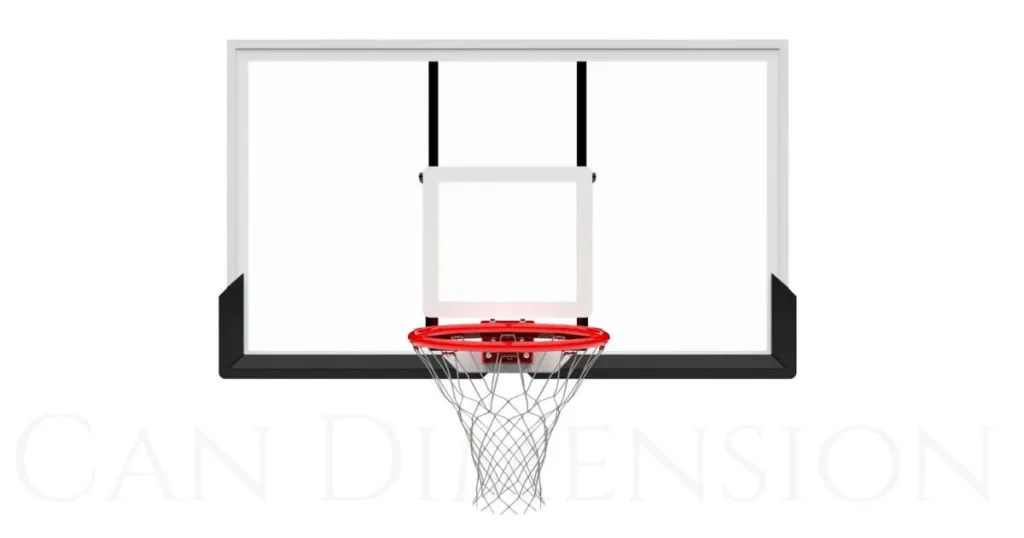
Basketball rims mount exactly 10 feet above the playing surface for all standard play. This height applies to NBA, NCAA, high school, and most youth leagues for players aged 12 and above. The measurement starts from the floor to the top of the rim.
Official backboards measure 72 inches wide by 42 inches tall. The rectangular backboard includes a smaller inner rectangle measuring 24 inches wide by 18 inches tall. This inner box helps players aim bank shots off the glass.
Regulation basketball rims have an 18-inch diameter. The rim attaches 6 inches from the backboard face. Metal rims feature breakaway mechanisms in professional and college play to prevent backboard damage from dunking.
Nets hang from the rim and measure 15 to 18 inches in length. White nylon nets are standard, though outdoor courts often use chain nets for weather resistance. The net slows the ball after successful shots.
Planning Your Basketball Court
Full Court vs Half Court Dimensions
A full regulation court requires substantial space. You need at least 94 feet by 50 feet (4,700 square feet) plus safety margins. Adding 5 feet of clearance on all sides increases the total footprint to 104 feet by 60 feet.
Half court basketball uses approximately 47 feet by 50 feet of space. This setup includes one basket and extends to the mid-court line. Half courts work well for driveways, backyards, and small gymnasiums.
Outdoor Basketball Court Sizing
The ideal outdoor basketball court matches indoor dimensions when space allows. However, many homeowners adapt measurements to fit available areas. A quality outdoor court needs at least 30 feet by 30 feet minimum.
A 30×30 space allows for basic basketball activities but feels cramped for full games. This size works for shooting practice and skill development. Serious players should aim for at least 40 feet by 50 feet for better gameplay.
Driveway courts typically range from 20 feet by 30 feet to 30 feet by 50 feet. The smaller size accommodates single-hoop setups perfect for family recreation. Concrete and asphalt provide durable outdoor surfaces that withstand weather exposure.
Other Dimensions: Pickleball Court Dimensions & Surfaces
FAQ’s
Q: What is a standard basketball court with dimensions?
A standard full-size basketball court measures 94 feet long by 50 feet wide in professional and college play. High school courts are slightly smaller at 84 feet by 50 feet. The rim sits 10 feet high, and the free throw line is 15 feet from the backboard across all levels.
Q: What are the dimensions of a high school basketball court?
High school basketball courts measure 84 feet in length and 50 feet in width. This creates a 4,200 square foot playing area. The court is 10 feet shorter than NBA and college courts but maintains the same width for proper lane spacing.
Q: Is 30×30 big enough for a basketball court?
A 30×30 foot area (900 square feet) works for basic basketball practice but is too small for regulation games. This space allows shooting drills, dribbling practice, and one-on-one play. For better gameplay, aim for at least 40 by 50 feet or larger.
Q: What is a good size for an outdoor basketball court?
An ideal outdoor basketball court measures at least 40 feet by 50 feet (2,000 square feet). This provides enough space for half-court games with proper movement. If building a full court, allocate 94 feet by 50 feet plus 5-foot safety margins on all sides.
Q: What size is a high school basketball hoop?
High school basketball hoops use the same dimensions as professional hoops. The rim diameter measures 18 inches, mounted exactly 10 feet above the floor. The backboard spans 72 inches wide by 42 inches tall, matching NCAA and NBA specifications.
Conclusion
Basketball court dimensions follow established standards that ensure fair competition and proper player development. Professional courts at 94 by 50 feet provide the gold standard, while high school courts at 84 by 50 feet accommodate younger athletes.
Understanding these measurements helps you make informed decisions whether constructing a home court or coaching a team. The 10-foot rim height and 15-foot free throw distance remain constant across all regulation play levels.

Haru, the dedicated Admin of candimension.com, curates an informational blog on Can Dimension. With passion and expertise, Haru delivers insightful articles to educate and empower readers on this fascinating niche.