Planning a parking lot? Getting the standard parking space dimensions right isn’t just about painting lines—it’s about safety, compliance, and maximizing your property’s functionality.
This guide covers everything from standard parking dimensions to ADA requirements, helping you design a parking lot that works efficiently and meets all regulations.
Parking Lot Dimensions
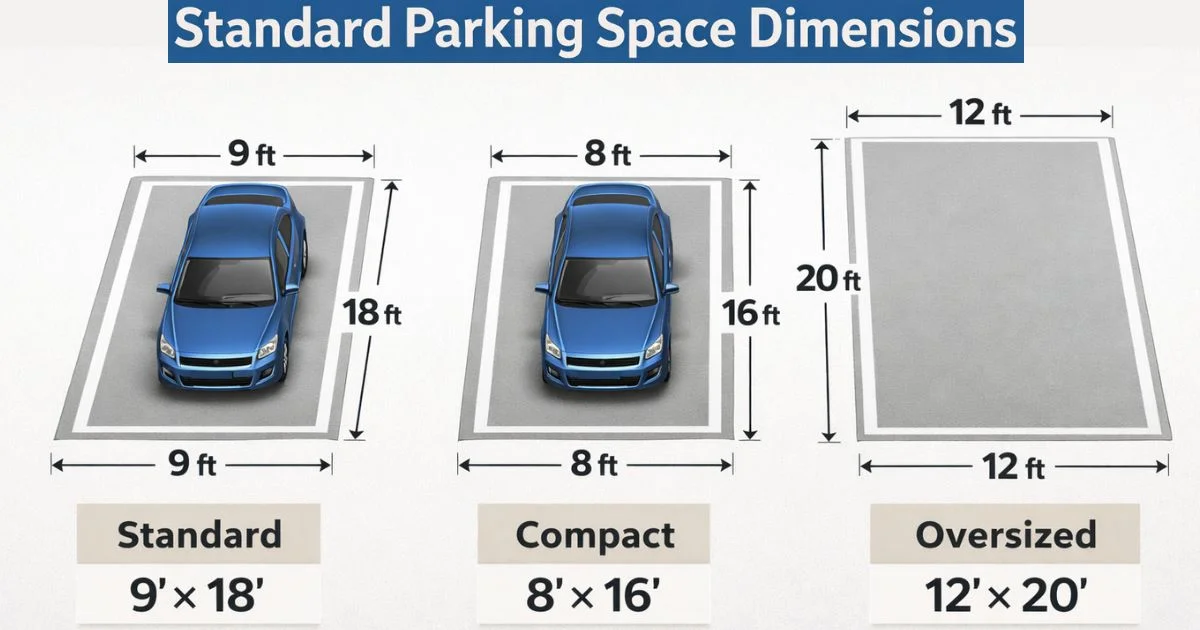
Standard parking space dimensions form the foundation of functional, compliant parking facilities. A 9-foot by 18-foot space works for most standard vehicles, while accessible parking requires specific widths, access aisles, and signage to Meet ADA Requirements.
Standard Parking Space Dimensions by Type
Accessible spots require a specific Access Aisle (striped area) adjacent to the parking spot.
60″
- Space Width: 8 ft (96″)
- Access Aisle: 5 ft (60″)
- Best for: Standard wheelchair vans/cars.
96″
- Option A: 11 ft Space + 5 ft Aisle
- Option B: 8 ft Space + 8 ft Aisle
- Required for lifts/ramps.
| Total Parking Spaces | Required Accessible Spaces |
|---|---|
| 1 to 25 | 1 |
| 26 to 50 | 2 |
| 51 to 75 | 3 |
| 76 to 100 | 4 |
| 101 to 150 | 5 |
- For every six accessible spaces, at least one must be van-accessible.
- Hospital outpatient facilities require 10% accessible parking.
- Rehabilitation facilities require 20% accessible parking.
Parking Lot Aisle Width Standards
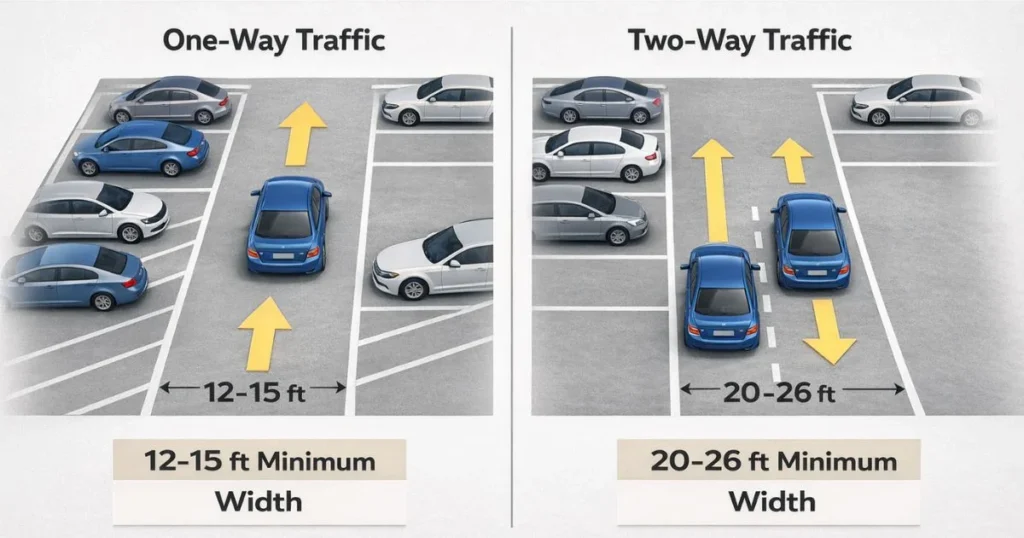
Aisle width directly impacts traffic flow and safety. Too narrow, and drivers struggle to navigate. Too wide, and you’re wasting valuable space that could hold more vehicles.
One-Way vs. Two-Way Traffic Aisles
One-way aisles range from 12-15 feet wide depending on your parking angle. These work well for smaller lots where controlled traffic flow reduces congestion and confusion.
Two-way aisles require 20-26 feet minimum width. This allows vehicles to pass each other comfortably while drivers are pulling in or backing out of spaces.
The parking angle you choose determines your minimum aisle width. Steeper angles need wider aisles because vehicles require more turning radius.
Angled Parking Configurations
30-degree angle parking uses the narrowest aisles at 12 feet wide. Each space typically measures 17 feet deep by 8.5 feet wide. This configuration works best for low-traffic areas where slower speeds are expected.
45-degree angle parking requires 13-14 foot wide aisles for one-way traffic. Space dimensions are approximately 18 feet deep by 9 feet wide. This is one of the most popular layouts because it balances space efficiency with ease of use.
60-degree angle parking needs 16-18 foot wide aisles for smooth operation. Spaces measure roughly 18-19 feet deep by 9 feet wide. This angle allows faster entry and exit compared to 45-degree parking, making it ideal for high-turnover commercial areas like shopping centers.
90-degree perpendicular parking requires the widest aisles at 24-26 feet for two-way traffic. Standard spaces are 18 feet deep by 9 feet wide. While this layout needs more aisle space, it maximizes the number of parking spots along each row.
Other Dimensions: What Are Standard Garage Door Dimensions?
Question’s
What is the standard size for car parking?
The standard parking space size in the United States is 9 feet wide by 18 feet long for regular vehicles. This measurement provides adequate room for most cars, SUVs, and light trucks while allowing drivers to open doors comfortably.
How big is a 50 space parking lot?
A 50-space parking lot with standard 9×18 ft spaces and 24-ft two-way aisles requires approximately 12,000-15,000 square feet total. The exact size depends on your layout configuration, landscaping islands, and required buffer zones.
What is the standard length of a parking lot line?
Parking space striping lines are typically 18-20 feet long for standard perpendicular spaces and 22-24 feet for parallel spaces. Line width is usually 4-6 inches, though some jurisdictions require specific dimensions.
What is a 60 degree parking space?
A 60-degree parking space sits at a 60-degree angle relative to the parking aisle. This configuration requires a 16-18 foot aisle width and provides easier entry and exit compared to 90-degree parking, making it popular for high-traffic commercial lots.
What is 45 degree parking called?
45-degree parking is called “angle parking” or “diagonal parking.” It’s commonly used in retail centers, shopping malls, and commercial areas with high vehicle turnover because it allows faster parking maneuvers than perpendicular spaces.
Is 20 ft wide enough for a 2 car garage?
Yes, 20 feet wide is adequate for a standard two-car garage, allowing two 9-10 ft wide parking spaces side by side. Most residential garages are 20-24 feet wide to accommodate two vehicles with some walking space between them.
Is there a minimum size for a car parking space?
Yes, most U.S. municipalities require a minimum of 8.5-9 feet wide by 18 feet long for standard parking spaces. However, local building codes vary significantly, so always check your specific jurisdiction’s requirements before designing a parking lot.
How to design a parking lot layout?
Design parking lots by: (1) determining total space requirements based on building codes, (2) choosing appropriate parking angles (45°, 60°, or 90°), (3) calculating proper aisle widths for safe traffic flow, (4) ensuring ADA compliance with required accessible spaces, (5) planning drainage and lighting systems, and (6) verifying compliance with local building and fire codes.
How many parking spaces is 20 meters?
20 meters (approximately 65.6 feet) can fit about 3-4 standard parking spaces at 18-20 feet each when arranged end-to-end, or 7-8 spaces at 8-9 feet each when arranged side-by-side. The actual number depends on your space dimensions and layout configuration.

Haru, the dedicated Admin of candimension.com, curates an informational blog on Can Dimension. With passion and expertise, Haru delivers insightful articles to educate and empower readers on this fascinating niche.
